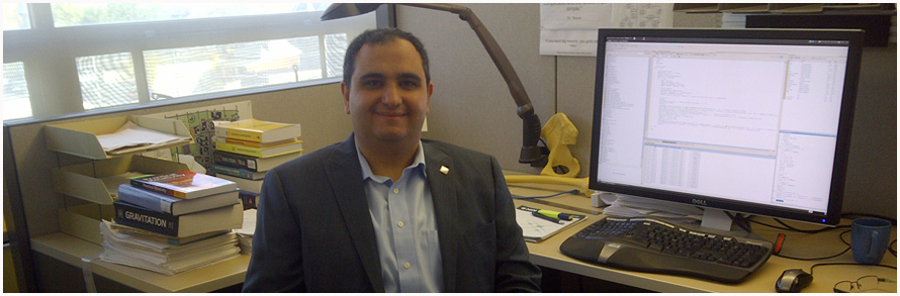
Mohamed S. Hefny, PMP, PEng, MSc, PhD (candidate) School of Computing,
Queens University, Kingston, ON K7L 2N8, Canada Tel:
1-613-533-6876 | Fax: 1-613-533-6513 | e-mail:
hefny@cs.queensu.ca
|
|
|
         |
|
|
Mohamed Hefny is a
PhD candidate at Queen’s University School of Computing; working under
supervision of Professor Randy Ellis. He received a BSc in Computer
Science with double minor in Electronics and Mathematics (1998) and a
MSc in Computer Science with a focus in Artificial Intelligence (2001),
both from The American University in Cairo. He is also a certified
Project Management Professional (PMP) by the Project Management
Institute (PMI) and a licensed Professional Engineer (PEng) by
Professional Engineers Ontario (PEO).
Mr. Hefny earned several
prestigious awards and scholarships including HMRC-CREATE Program in
Bone and Joint Health Technologies Scholarship from the Natural Sciences
and Engineering Research Council (2012–2013), the SPIE Scholarship in
Optics and Photonics from the International Society for Optics and
Photonics (2011–2012), the Ontario Graduate Scholarship from the
government of Ontario (2011-2012), the SPIE Scholarship in Optical
Science and Engineering from the International Society for Optics and
Photonics (2010-2011), the Alexander Graham Bell Canada Graduate
Scholarship from the Natural Sciences and Engineering Research Council
(2009-2011), the Ontario Graduate Scholarship in Science and Technology
from the government of Ontario and Queen’s University (2008-2009), the
Excellence in Teaching Assistantship Award from Queen’s University
School of Computing (2008-2009), and the Graduate Merit Fellowship Award
from The American University in Cairo (1999-2000).
Mr. Hefny has
over 10 years experience in technical consulting and project management
in healthcare and education technology projects, and over 5 years
experience in interdisciplinary academic teaching and research. He is
interested in applying computer science to enhance health care services
by collaborating with medicine, engineering, and health sciences
researchers. His doctoral thesis examines the use of differential
geometry for analysing complex shapes in computational anatomy. He is
developing fundamental algorithms and core technologies to assist
surgeons in the operating room by increasing the efficiency and the
quality of surgeries.
|